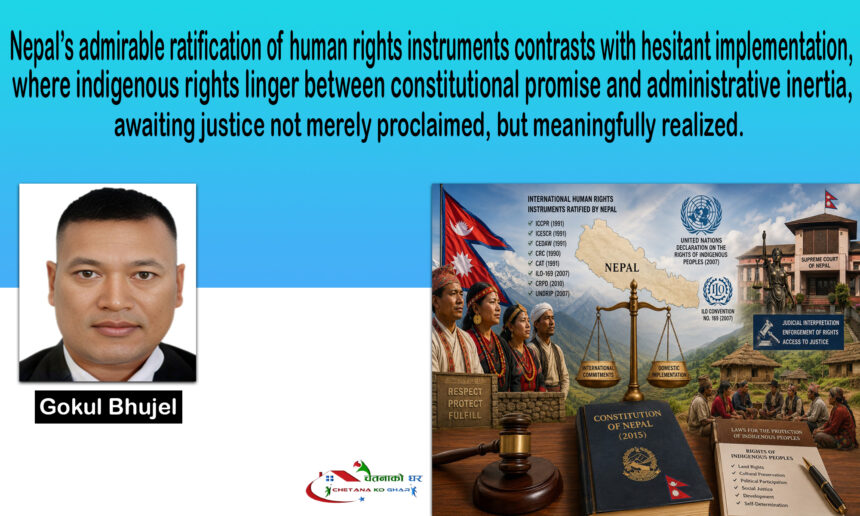
Nepal has demonstrated a strong formal commitment to international human rights through the ratification of numerous core instruments, complemented by constitutional guarantees and statutory protections. Notably, provisions concerning indigenous peoples reflect alignment with global legal standards, including recognition of cultural, social, and political rights. However, a persistent gap remains between these normative commitments and their effective implementation. Indigenous communities continue to face structural challenges relating to land, resources, representation, and cultural preservation. While judicial interpretation has advanced rights discourse, administrative limitations and socio-political constraints hinder enforcement, underscoring the need for coherent policies, institutional strengthening, and inclusive governance mechanisms.
Nepal has consistently presented itself as a state committed to the advancement of international human rights norms, most visibly demonstrated through its extensive ratification of core global human rights instruments. Over the decades, the country has acceded to a wide range of treaties encompassing civil, political, economic, social, and cultural rights, thereby embedding itself firmly within the framework of international human rights law. While these commitments are noteworthy, they also invite a deeper and more critical examination: to what extent have these international obligations translated into meaningful protection and empowerment for historically marginalized communities, particularly indigenous peoples? The structure of Nepal’s human rights commitments is both comprehensive and significant. The country ratified the International Covenant on Civil and Political Rights in 1991, along with its Optional Protocols, including the Second Optional Protocol aimed at abolishing the death penalty. In the same year, Nepal also ratified the International Covenant on Economic, Social and Cultural Rights, reflecting its formal commitment to safeguarding socio-economic entitlements. The Convention on the Elimination of All Forms of Discrimination Against Women, ratified in 1991 and followed by its Optional Protocol in 2001, further demonstrates Nepal’s obligations toward gender equality. Similarly, the Convention on the Rights of the Child, ratified in 1990, together with its Optional Protocols addressing child soldiers and exploitation, reinforces the country’s commitment to protecting vulnerable populations.
Nepal’s engagement with international human rights law extends beyond these foundational instruments. The ratification of the Convention Against Torture in 1991 and the Convention on the Rights of Persons with Disabilities in 2010 reflects a broader recognition of the need to protect individuals from systemic abuse and discrimination. Of particular importance is Nepal’s ratification of the International Labor Organization Convention No. 169 in 2007, making it the first country in South Asia to take this step. This convention, which specifically addresses the rights of indigenous and tribal peoples, represents a significant milestone in recognizing collective rights, cultural autonomy, and participatory governance. Complementing this commitment, Nepal endorsed the United Nations Declaration on the Rights of Indigenous Peoples in the same year, further strengthening its normative obligations. These international commitments are not merely symbolic. Under Nepal’s Treaty Act of 1990, ratified treaties acquire the force of domestic law. In cases of inconsistency between national legislation and international obligations, treaty provisions prevail. This legal framework, in principle, establishes a strong foundation for the protection of human rights, including those of indigenous communities. However, the central issue lies not in the breadth of commitments, but in the depth and effectiveness of their implementation. Indigenous peoples in Nepal constitute a significant segment of the population, characterized by rich cultural diversity and distinct social identities. Despite constitutional recognition and statutory safeguards, these communities have historically faced marginalization, exclusion, and limited access to resources. Persistent issues related to land ownership, natural resource management, cultural preservation, and political representation continue to undermine their full participation in national life. While legal provisions exist, their practical realization often remains limited.
The Constitution of Nepal (2015) represents a progressive effort to institutionalize human rights within the domestic legal framework. It guarantees fundamental rights such as equality before the law, nondiscrimination, and social justice. Specific provisions addressing the rights of indigenous communities reflect a commitment to inclusivity and recognition. Articles guarantee cultural rights, religious freedoms, and social justice aim to create an environment in which marginalized groups can assert their identity and actively participate in national development. In addition to constitutional guarantees, statutory frameworks such as the National Foundation for Upliftment of Indigenous Nationalities Act, 2002, have been established to promote the welfare of indigenous peoples. These mechanisms are designed to safeguard cultural heritage, improve socio-economic conditions, and ensure representation in governance structures. However, the mere existence of legal provisions does not guarantee effective protection. The gap between normative commitments and practical enforcement remains a central challenge. One of the most critical concerns facing indigenous communities relates to land and resource rights. Traditional land tenure systems, often rooted in customary practices, have not been fully recognized within the formal legal system. Development initiatives, including infrastructure projects and natural resource extraction, have in some instances proceeded without adequate consultation or compensation. This raises serious concerns about displacement, loss of livelihood, and erosion of traditional ways of life. Although international instruments emphasize the principle of free, prior, and informed consent, its implementation within Nepal remains inconsistent. Cultural preservation represents another area requiring urgent attention. Indigenous communities possess unique languages, traditions, and knowledge systems that contribute significantly to the nation’s cultural diversity. However, modernization, urbanization, and socio-economic pressures have contributed to the gradual erosion of these cultural identities. While legal provisions exist to protect cultural rights, their implementation often lacks sufficient institutional support and resources.
Political participation also remains uneven. Although constitutional provisions mandate inclusion and proportional representation, indigenous peoples continue to encounter barriers in accessing decision-making processes. Structural inequalities, limited access to education, and socio-economic constraints hinder their effective participation in governance. As a result, policies affecting indigenous communities are often formulated without adequate representation of their perspectives.
The judiciary has played an important role in addressing some of these challenges. The Supreme Court of Nepal has, in several cases, interpreted constitutional provisions in light of international human rights standards, thereby strengthening the protection of indigenous rights. Judicial decisions have addressed issues ranging from land rights to cultural autonomy, frequently invoking international instruments as interpretative tools. This reflects an evolving jurisprudence aimed at harmonizing domestic law with international norms. However, judicial intervention alone is insufficient to address systemic challenges. The implementation of court decisions often encounters administrative obstacles, resource limitations, and institutional inefficiencies. Furthermore, judicial responses are typically case-specific, addressing individual grievances rather than providing comprehensive solutions. As such, while the judiciary serves as an essential safeguard, it cannot substitute for broader policy and institutional reforms.
Administrative capacity remains a critical factor in the effective implementation of indigenous rights. Enforcement of legal provisions require well-coordinated institutions, adequate resources, and trained personnel. In many cases, the absence of these elements results in fragmented and inconsistent implementation. Decentralization, while intended to strengthen local governance, has also introduced challenges related to coordination and accountability. Social attitudes and entrenched biases continue to present significant barriers. Historical inequalities and deeply rooted perceptions have contributed to the marginalization of indigenous communities. Addressing these challenges requires not only legal reform but also broader societal transformation. Public awareness, education, and inclusive policy measures are essential to fostering a culture of equality and respect. The relationship between international commitments and domestic realities highlights the complexity of human rights implementation. While Nepal has demonstrated strong engagement with global norms, the translation of these commitments into tangible outcomes remains uneven. This underscores the need for a more integrated and coherent approach that combines legal reform, institutional strengthening, and active community participation. Policy coherence is essential in this regard. Aligning domestic legislation with international obligations requires systematic review and harmonization of existing laws. Inconsistencies must be addressed to ensure clarity, predictability, and enforceability. The incorporation of international standards into national policies should be accompanied by clear implementation strategies and accountability mechanisms. Strengthening institutional capacity is equally important. Government bodies responsible for implementing indigenous rights must be equipped with sufficient resources, technical expertise, and administrative support. Effective coordination among different levels of government is necessary to ensure consistency and avoid duplication. Monitoring and evaluation mechanisms should also be developed to assess progress and identify areas requiring improvement.
Community participation must be at the center of these efforts. Indigenous peoples should be actively involved in decisions that affect their lives, not merely as beneficiaries but as equal partners. This includes meaningful consultation, participation in policy formulation, and access to information. Empowering communities through education and capacity-building can enhance their ability to assert their rights and contribute to national development. The role of civil society and international organizations is also significant. Through advocacy, research, and technical assistance, these actors can complement state efforts and promote more effective implementation. Collaborative approaches that involve multiple stakeholders are essential for addressing the complex and interconnected challenges associated with indigenous rights.
Ultimately, the protection of indigenous peoples’ rights in Nepal is not only a legal obligation but also a fundamental requirement for achieving justice, equality, and inclusive development. It reflects the broader values of democratic governance and social cohesion. Ensuring that legal commitments are translated into real and measurable improvements in the lives of indigenous communities requires sustained effort, political will, and collective responsibility. Nepal stands at an important stage in its human rights journey. The foundation established through international commitments and constitutional guarantees provides a strong basis for progress. However, the true measure of this commitment lies in its impact on the most marginalized members of society. Bridging the gap between commitments and realities is both a necessity and an urgent priority. A future in which indigenous communities can fully exercise their rights where their cultures are preserved, their voices are heard, and their livelihoods are secured is both achievable and essential. Realizing this vision requires more than legal frameworks; it demands consistent implementation, inclusive governance, and a genuine commitment to equality. Only then can Nepal ensure that its human rights commitments are not merely aspirational, but truly transformative.
Conclusion: Nepal’s extensive engagement with international human rights instruments reflects a commendable normative commitment to the protection and promotion of fundamental rights, including those of indigenous peoples. The constitutional framework and statutory provisions further reinforce this commitment, establishing a robust legal foundation aligned with global standards. However, the persistent disparity between formal obligations and practical implementation continues to undermine the full realization of these rights. Indigenous communities remain disproportionately affected by structural inequalities, particularly in relation to land rights, cultural preservation, and meaningful political participation. While judicial interventions have contributed to the progressive interpretation of rights, their impact remains limited in the absence of coherent policy execution and institutional capacity. The imperative, therefore, lies in translating legal commitments into tangible outcomes through harmonized legislation, strengthened administrative mechanisms, and inclusive governance. Ensuring effective participation of indigenous peoples in decision-making processes is essential to bridging this gap. Ultimately, the credibility of Nepal’s human rights commitments will be measured not by the breadth of its ratifications, but by the depth of their implementation. A sustained and coordinated effort is required to ensure that constitutional guarantees evolve from aspirational principles into lived realities for all.
Author: The author is a scholar and policy analyst specializing in public administration, sustainable development, and legislative drafting.
References
Key International Human Rights Instruments Ratified by Nepal
- United Nations. (1971). International Convention on the Elimination of All Forms of Racial Discrimination (ICERD). Acceded by Nepal on January 30, 1971.
- United Nations. (1990). Convention on the Rights of the Child (CRC). Ratified by Nepal on September 14, 1990. Optional Protocols: Involvement of Children in Armed Conflict (2005); Sale of Children, Child Prostitution, and Child Pornography (2006).
- United Nations. (1991). Convention on the Elimination of All Forms of Discrimination Against Women (CEDAW). Ratified by Nepal on April 22, 1991. Optional Protocol: 2007.
- United Nations. (1991). International Covenant on Civil and Political Rights (ICCPR). Acceded by Nepal on May 14, 1991. First Optional Protocol (1991); Second Optional Protocol on the Abolition of the Death Penalty (1998).
- United Nations. (1991). International Covenant on Economic, Social and Cultural Rights (ICESCR). Acceded by Nepal on May 14, 1991.
- United Nations. (1991). Convention Against Torture and Other Cruel, Inhuman or Degrading Treatment or Punishment (CAT). Acceded by Nepal in 1991.
- United Nations. (2010). Convention on the Rights of Persons with Disabilities (CRPD). Ratified by Nepal on May 7, 2010. Optional Protocol on Individual Complaints.
- International Labor Organization. (2007). Convention No. 169 concerning Indigenous and Tribal Peoples (ILO-169). Ratified by Nepal on August 22, 2007.
- United Nations. (2007). United Nations Declaration on the Rights of Indigenous Peoples (UNDRIP). Supported by Nepal in 2007.
- International Committee of the Red Cross. (1949). Geneva Conventions. Acceded by Nepal on February 7, 1964.
- United Nations. (1969). International Convention on the Prevention and Punishment of the Crime of Genocide. Acceded by Nepal on January 17, 1969.
Key National Legal Instruments of Nepal
- Constitution of Nepal, 2015 (2072 BS). Kathmandu: Government of Nepal.
- National Foundation for the Upliftment of Indigenous Nationalities Act, 2002 (Adibasi Janajati Uththan Rashtriya Pratisthan Ain, 2058 BS). Kathmandu: Government of Nepal.
- Civil Service Act, 1992 (Nijamati Sewa Ain, 2049 BS). Kathmandu: Government of Nepal.
- Civil Service Regulations, 1993 (Nijamati Sewa Niyamawali, 2050 BS). Kathmandu: Government of Nepal.
- Interim Constitution of Nepal, 2007 (Nepal ko Antim Samvidhan, 2063 BS). Kathmandu: Government of Nepal.
- National Inclusive Commission Act, 2017 (Rastriya Samaveshi Aayog Ain, 2074 BS). Kathmandu: Government of Nepal.
- National Inclusive Commission Regulations, 2022 (Rastriya Samaveshi Aayog Niyamawali, 2079 BS). Kathmandu: Government of Nepal.
- Tharu Commission Act, 2017 (Tharu Aayog Ain, 2074 BS). Kathmandu: Government of Nepal.
- Tharu Commission Regulations, 2021 (Tharu Aayog Niyamawali, 2078 BS). Kathmandu: Government of Nepal.
References: Key judgement of Supremecourt of Nepal
- Lawyers’ Group on Human Rights of Indigenous Peoples in Nepal (LAHURNIP), Anamnagar, Kathmandu, including Advocate Shankar Limbu. (n.d.). Ref. No. 074-WO-0053: Order, including stay/injunction.
- Case No. 069–WO–0749, Petitioner: Surendra Swar Moktan, et al.
- Case No. 069–WO–1100, Petitioner: Ramesh Pradhan, et al.
- Case No. 069–WO–1187, on behalf of Sindhuli Secondary School, Petitioner: Rudra Bahadur Khatri
References: Official Websites
- Office of the United Nations High Commissioner for Human Rights (OHCHR). Universal Periodic Review (UPR). Retrieved from: https://www.ohchr.org/en/hr-bodies/upr/upr-home
- International Labour Organization (ILO). Eighteenth Session – United Nations Permanent Forum on Indigenous Issues. Retrieved from: https://www.ilo.org/meetings-and-events/ilo-eighteenth-session-united-nations-permanent-forum-indigenous-issues
- International Labour Organization (ILO) – Nepal. Regions and Countries: Asia and the Pacific. Retrieved from: https://www.ilo.org/regions-and-countries/asia-and-pacific/nepal
- Nepal Law Commission. Retrieved from: https://lawcommission.gov.np/
- National Human Rights Commission (NHRC) Nepal. Retrieved from: https://www.nhrcnepal.org/#
- World Bank Inspection Panel. Retrieved from: https://www.inspectionpanel.org/
- Supreme Court of Nepal. Retrieved from: https://supremecourt.gov.np/web/
- International Work Group for Indigenous Affairs (IWGIA). Retrieved from: https://iwgia.org/en/
- Asia Indigenous Peoples Pact (AIPP). Retrieved from: https://aippnet.org/
- Office of the Prime Minister and Council of Ministers (OPMCM), Nepal. Retrieved from: https://www.opmcm.gov.np/
Lawyers’ Association for Human Rights of Nepalese Indigenous Peoples (LAHURNIP). Retrieved from: https://www.lahurnip.org/
- National Indigenous Nationalities Commission (NINC), Nepal. Retrieved from: https://ninc.gov.np/
References: Reports
- National Inclusive Commission, Nepal. (2023/24 BS 2080/81). Sixth Annual Report (Synopsis). Kathmandu: Government of Nepal.
- National Human Rights Commission, Nepal. Universal Periodic Review – Nepal. Retrieved from: https://www.ohchr.org/en/hr-bodies/upr/upr-home
- Government of Nepal. (2025/26 BS 2082/83). Policy and Program of the Fiscal Year 2082/83. Kathmandu: Ministry of Finance, Nepal.
- World Bank Inspection Panel. (n.d.). First Dispute Resolution Service Outcome: Parties Settle in Nepal Electricity Transmission Line Project Case. Washington, DC: World Bank. Retrieved from: https://www.inspectionpanel.org/
References: Journals
- Nepal Law Review (NLR). (2026, January). The NHRI Nepal joint submission for the Fourth Cycle Universal Periodic Review of Nepal. Kathmandu: National Human Rights Institutions – Nepal.
- United Nations. (2024). Reports on the indigenous issue. New York: United Nations.