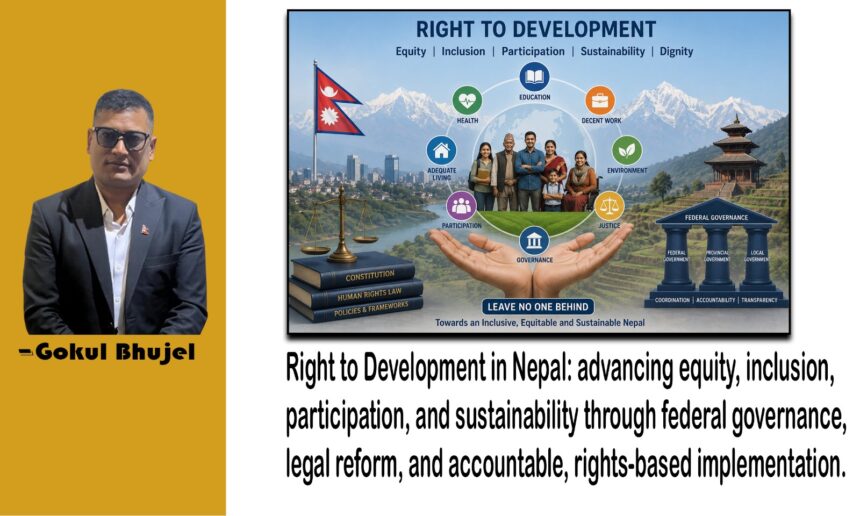
Abstract:
This study examines the Right to Development as a fundamental human right and a normative framework for inclusive, equitable, and sustainable progress, with a focus on Nepal’s legal, political, administrative, and practical context. The objective is to analyze the conceptual foundations, multidimensional nature, and contemporary relevance of the Right to Development, and to identify challenges and pathways for effective realization within a federal governance structure. The research adopts a qualitative, doctrinal, and normative methodology, relying on desk based analysis of UN instruments, international treaties, national laws, policy documents, academic literature, and expert discussions. Thematic and interpretive analysis is applied to assess key principles, obligations, and operational dimensions of the Right to Development. The study finds that while Nepal’s Constitution and policy frameworks provide a normative basis, legal gaps, political instability, administrative limitations, and socio economic inequalities constrain implementation. Effective realization requires harmonized legislation, strengthened judicial enforcement, political commitment to rights based development, intergovernmental coordination, and inclusive, participatory governance. Targeted interventions for marginalized groups and transparent monitoring mechanisms are critical to ensure equitable access to development opportunities. The study concludes that the Right to Development is both a moral and legal imperative and a practical framework that can guide Nepal’s development policies. Its realization depends on coordinated action across federal, provincial, and local levels, complemented by community engagement and international cooperation. Recommendations include adopting rights based budgeting, evidence based planning, participatory decision making, and inclusive social policies to transform the principles of the Right to Development into tangible, measurable outcomes for human wellbeing.
Key words: Right to Development; Human-Centred Development; Equity and Inclusion; Legal and Policy Frameworks; Federal Governance and Implementation
Introduction
Development has long transcended the narrow confines of economic growth to emerge as a holistic process aimed at the constant improvement of human well being and the expansion of substantive freedoms. In contemporary international discourse, development is increasingly understood as a people centred, rights based, and equity oriented process that enables individuals and peoples to participate meaningfully in, contribute to, and enjoy economic, social, cultural, and political progress. Within this evolving normative framework, the Right to Development occupies a distinctive and transformative position in international human rights law and global development diplomacy.
The Right to Development was formally articulated by the international community through the United Nations Declaration on the Right to Development, adopted by the UN General Assembly in 1986. The Declaration affirms that development is an inalienable human right, by virtue of which every human person and all peoples are entitled to participate in, contribute to, and enjoy development, in which all human rights and fundamental freedoms can be fully realized. This recognition marked a paradigm shift from viewing development as a discretionary policy objective to affirming it as a legally and morally grounded entitlement rooted in human dignity, equality, and justice.
At its conceptual core, development is not merely the accumulation of material wealth, but a comprehensive process that enlarges human capabilities, strengthens institutional accountability, and advances social justice. Influential development scholarship and UN policy frameworks have emphasized that development encompasses freedom from poverty, access to education and health, gender equality, cultural integrity, environmental sustainability, democratic participation, and respect for human rights. Accordingly, the Right to Development integrates civil, political, economic, social, and cultural rights into a unified normative vision, rejecting artificial hierarchies among rights and underscoring their indivisibility and interdependence.
Globally, the Right to Development has been discussed and elaborated through multiple interconnected dimensions. First, it embodies an individual and collective dimension, recognizing both persons and peoples as right holders. Second, it carries a national and international dimension, affirming that while States bear primary responsibility for creating enabling domestic conditions, the realization of the Right to Development also depends on equitable international economic relations, fair trade, development cooperation, and global solidarity. Third, it reflects a process oriented dimension, emphasizing participation, transparency, accountability, and non discrimination in development decision making. Fourth, it incorporates a distributive justice dimension, requiring that the benefits of development be shared fairly, with particular attention to marginalized and vulnerable groups.
In the context of globalization, persistent structural inequalities, climate change, technological asymmetries, and unequal access to resources, the Right to Development has gained renewed relevance as a normative compass for international cooperation. Academic debates, policy reports, and multilateral dialogues have increasingly linked the Right to Development with the Sustainable Development Goals (SDGs), the human rights based approach to development, and South South as well as triangular cooperation frameworks. These discussions highlight that development cannot be sustainable unless it is inclusive, rights respecting, and anchored in international cooperation based on mutual respect and shared responsibility.
Despite its normative recognition, the Right to Development remains one of the most debated and, at times, contested concepts in international law and diplomacy. Divergent interpretations regarding its legal status, implementation mechanisms, and the scope of international obligations have shaped scholarly discourse and intergovernmental negotiations. Nevertheless, the continued engagement of the United Nations, regional organizations, academic institutions, and civil society demonstrates a growing consensus that the Right to Development provides a vital ethical and legal foundation for addressing global inequalities and advancing a more just international order.
Against this backdrop, this article situates the Right to Development as a central pillar of contemporary development diplomacy and international human rights law. By examining its conceptual foundations, multidimensional nature, and evolving global discourse, the study seeks to contribute to a deeper understanding of the Right to Development as both a normative standard and a practical framework for achieving inclusive, equitable, and sustainable development for all.
Methodology
This study adopts a qualitative, doctrinal, and normative approach, based on desk based analysis of legal and policy texts, to examine the Right to Development. It relies on secondary sources including UN documents, international treaties, national laws, academic literature, policy reports, and recorded expert discussions. The research uses thematic and interpretive analysis to identify key principles, obligations, and multidimensional aspects of the Right to Development. Guided by a human rights based framework, the study emphasizes universality, participation, accountability, and international cooperation. Ethical standards are maintained through the exclusive use of publicly available, credible sources, ensuring reliability and academic rigor.
The Right to Development: Evolution and Origin
The concept of the Right to Development did not emerge suddenly within international law; rather, it evolved gradually through decades of intellectual debate, political struggle, and normative development in the international system. Its origin lies at the intersection of human rights discourse, post colonial aspirations, and the quest for a more equitable international economic order. Understanding the evolution of the Right to Development therefore requires situating it within the broader historical, political, and legal transformations of the twentieth century.
Early Foundations: From Economic Growth to Human Centred Development
In the immediate post Second World War period, development was largely understood in economic terms, focusing on industrialization, capital accumulation, and gross domestic product growth. Early development paradigms promoted by international financial institutions emphasized modernization and economic expansion as the primary pathways to progress. However, by the 1950s and 1960s, it became increasingly evident that economic growth alone did not automatically translate into improved living conditions, social justice, or human dignity for large segments of the global population. At the same time, the emergence of the modern international human rights framework, beginning with the Universal Declaration of Human Rights (1948), laid the normative groundwork for a more holistic understanding of development. Although the Universal Declaration did not explicitly refer to a “right to development,” it recognized a broad range of civil, political, economic, social, and cultural rights that implicitly required enabling social and economic conditions for their realization. Development, therefore, began to be viewed not merely as a policy objective, but as a process intrinsically linked to human rights and human well being.
Decolonization and the Collective Dimension of Development
The formal articulation of the Right to Development is closely linked to the decolonization movement of the 1950s–1970s. Newly independent States in Africa, Asia, and Latin America faced profound structural inequalities inherited from colonial rule, including economic dependency, unequal trade relations, and limited control over natural resources. For these States, development was not only an economic necessity but also an expression of sovereignty, self determination, and collective dignity. The principle of self determination, recognized in Article 1 of both the International Covenant on Civil and Political Rights and the International Covenant on Economic, Social and Cultural Rights (1966), played a critical role in shaping the collective dimension of the Right to Development. Development was increasingly framed as a right of peoples, not only individuals, emphasizing national ownership of development strategies and equitable participation in the international economic system.
During this period, developing countries, particularly through the Non Aligned Movement and the Group of 77, advocated for a New International Economic Order (NIEO). This initiative called for fairer trade, technology transfer, development assistance, and restructuring of global economic governance. Although the NIEO agenda faced political resistance, it significantly influenced the normative evolution of the Right to Development by highlighting the international obligations necessary for meaningful development.
Intellectual Contributions and Normative Consolidation
The intellectual foundations of the Right to Development were strengthened by influential scholars and development thinkers who challenged narrow economic models. Concepts such as “basic needs,” “human development,” and later “capabilities and freedoms” emphasized that development should expand people’s choices, capabilities, and substantive freedoms. These ideas reinforced the understanding that development is a comprehensive process encompassing education, health, participation, equality, and social justice. Within the United Nations system, this evolving thinking found expression in various resolutions, policy debates, and expert studies. The United Nations increasingly recognized that development and human rights are mutually reinforcing and that the absence of one undermines the other. This normative convergence created the conditions for the formal recognition of the Right to Development as a distinct human right.
The 1986 UN Declaration on the Right to Development
The adoption of the United Nations Declaration on the Right to Development in 1986 marked a historic milestone in international human rights law. For the first time, the international community explicitly affirmed that development is an inalienable human right. The Declaration defined the Right to Development as a right by virtue of which every human person and all peoples are entitled to participate in, contribute to, and enjoy development, in which all human rights and fundamental freedoms can be fully realized. The Declaration introduced several transformative principles. It recognized both individual and collective right holders, affirmed the primary responsibility of States for national development, and emphasized the role of international cooperation in removing obstacles to development. It also underscored key process oriented principles such as participation, equality, non discrimination, and fair distribution of development benefits. Importantly, the Declaration rejected any hierarchy among human rights, reaffirming their indivisibility and interdependence. Although adopted by a majority vote rather than consensus, the Declaration has since acquired significant normative authority. It serves as a moral, political, and interpretive framework guiding UN institutions, development policies, and human rights mechanisms .
Post Declaration Developments and Contemporary Relevance
Since 1986, the Right to Development has continued to evolve through UN resolutions, expert mechanisms, and scholarly engagement. The establishment of the Working Group on the Right to Development and the mandate of the Special Rapporteur have contributed to clarifying its content, identifying obstacles to implementation, and strengthening its normative coherence.
In recent decades, the Right to Development has been increasingly linked with global agendas such as the Millennium Development Goals and the Sustainable Development Goals. These frameworks reflect many core elements of the Right to Development, including poverty eradication, equality, participation, sustainability, and international cooperation. Climate change, global health crises, digital divides, and economic inequality have further reinforced the relevance of the Right to Development as a guiding principle for global solidarity and shared responsibility.
Evolution as a Living Norm
The evolution of the Right to Development demonstrates that it is not a static or abstract concept, but a living normative framework shaped by historical experience, global power relations, and changing development challenges. While debates regarding its legal status and enforceability continue, there is growing recognition that the Right to Development provides an essential ethical and legal foundation for re imagining development as a human centred, rights based, and justice oriented process.
In this sense, the Right to Development represents both the culmination of decades of normative evolution and an ongoing project aimed at transforming development practice in line with the principles of human dignity, equality, and international cooperation.
Contemporary Features of the Right to Development
In the contemporary international legal and policy landscape, the Right to Development has evolved into a comprehensive normative framework that responds to complex global challenges such as inequality, climate change, technological transformation, and persistent development gaps. While rooted in the 1986 United Nations Declaration on the Right to Development, its present day features reflect continuous interpretation and elaboration through United Nations mechanisms, academic scholarship, and global development practice. The following key characteristics define the Right to Development in the current era.
Human Centred and People Oriented Development
At its core, the contemporary Right to Development is explicitly human centred. Development is no longer understood merely as economic growth or infrastructure expansion, but as a process aimed at improving the overall well being, dignity, and freedoms of individuals and peoples. Human beings are recognized as both the central subjects and primary beneficiaries of development. This feature reflects a shift from growth focused models to development approaches that prioritize human capabilities, quality of life, and social justice.
Integration of All Human Rights
A defining feature of the Right to Development today is its holistic and integrative nature. It brings together civil, political, economic, social, and cultural rights within a single normative vision. The contemporary understanding rejects any hierarchy among rights and emphasizes their indivisibility and interdependence. Development is considered incomplete if economic progress is achieved at the expense of political freedom, social inclusion, cultural identity, or environmental protection.
Individual and Collective Dimensions
The Right to Development continues to maintain both individual and collective dimensions. On the one hand, every individual is a right holder entitled to participate in and benefit from development. On the other hand, peoples and communities are recognized as collective right holders, particularly in contexts involving self determination, control over natural resources, indigenous rights, and national development priorities. This dual dimension distinguishes the Right to Development from many other human rights norms.
Participation, Inclusion, and Democratic Governance
Meaningful participation is a central contemporary feature of the Right to Development. Development processes must be transparent, inclusive, and participatory, allowing individuals and communities to actively engage in decision making that affects their lives. Special emphasis is placed on the inclusion of marginalized and vulnerable groups, including women, children, persons with disabilities, indigenous peoples, and minorities. Democratic governance, accountability, and access to information are viewed as essential conditions for realizing the Right to Development.
Equality and Non Discrimination
In the present context, the Right to Development is strongly linked with substantive equality and non discrimination. Development outcomes and opportunities must be shared equitably, and structural inequalities must be addressed. This feature requires States and international actors to adopt targeted measures to eliminate poverty, gender inequality, social exclusion, and regional disparities. Equality is understood not only in formal terms but also in terms of actual outcomes and lived experiences.
National Responsibility and International Cooperation
A distinctive contemporary characteristic of the Right to Development is its dual obligation structure. States bear the primary responsibility for creating enabling national conditions for development, including sound policies, institutions, and legal frameworks. At the same time, the realization of the Right to Development depends on international cooperation, global partnerships, and shared responsibility. Fair trade, development assistance, debt sustainability, technology transfer, and reform of global economic governance are viewed as integral to fulfilling international obligations.
Process Oriented and Accountability Based Approach
The Right to Development today is increasingly understood as a process oriented right. It is not limited to final development outcomes but also concerns how development decisions are made and implemented. Transparency, accountability, rule of law, and access to remedies are essential components. This approach aligns the Right to Development with good governance principles and strengthens its operational relevance in development planning and evaluation.
Distributive Justice and Fair Sharing of Benefits
Distributive justice remains a core feature of the contemporary Right to Development. The benefits of development must be fairly distributed within and among States. This principle requires attention to income inequality, regional imbalances, and global disparities between developed and developing countries. In the international context, it reinforces the demand for a more equitable global economic order and solidarity based cooperation.
Sustainability and Intergenerational Equity
In light of global environmental challenges, sustainability has become an essential contemporary feature of the Right to Development. Development must meet the needs of the present without compromising the ability of future generations to realize their rights. Environmental protection, climate justice, and responsible use of natural resources are now firmly embedded within the understanding of the Right to Development.
Alignment with Global Development Agendas
The Right to Development in the present era is closely aligned with global development frameworks, particularly the Sustainable Development Goals (SDGs). The SDGs reflect many core elements of the Right to Development, including universality, inclusiveness, participation, equality, and international cooperation. This alignment has strengthened the practical relevance of the Right to Development as a guiding normative framework for global development diplomacy.
Concluding Observation
In its contemporary form, the Right to Development represents a mature and dynamic human rights norm that addresses both national and global dimensions of development. By combining human dignity, equality, participation, sustainability, and international solidarity, it provides a comprehensive ethical and legal framework for achieving inclusive, equitable, and sustainable development in an increasingly interconnected world.
The Right to Development: Comparative National Experiences and Lessons from Selected Regions
These regional examples demonstrate that the Right to Development is not a theoretical aspiration but a practical and achievable framework. While national contexts differ, successful implementation consistently reflects common principles: human centred policies, equality, participation, accountability, and international cooperation.
Asia: Republic of Korea (South Korea)
The Republic of Korea represents a strong Asian example of the successful realization of the Right to Development through a people centred and rights informed development model. Following post war poverty, Korea invested heavily in universal education, public health, land reform, and inclusive industrial policy. Over time, economic growth was accompanied by democratic transition, expansion of social protection, and institutional accountability. Development policies emphasized participation, human capital development, and equitable access to opportunities. Korea’s experience demonstrates how the Right to Development can be progressively realized when economic planning is aligned with social justice, political inclusion, and long term human development objectives.
Africa: Republic of Rwanda
Rwanda offers a notable African example of implementing the Right to Development through a national, inclusive, and accountability driven approach. Following the 1994 genocide, Rwanda adopted development strategies focused on poverty reduction, social inclusion, gender equality, and community participation. Universal health insurance, access to education, women’s political representation, and decentralised governance have strengthened human well being. Development planning in Rwanda emphasizes equity, national ownership, and results based accountability. While challenges remain, Rwanda’s experience illustrates how development grounded in dignity, participation, and equality reflects the core principles of the Right to Development.
North America: Canada
Canada exemplifies the Right to Development through a rights based development model rooted in equality, social justice, and international cooperation. Domestically, strong social protection systems, universal healthcare, education, and inclusive governance promote human well being and equal opportunity. Canada’s constitutional and legal framework integrates human rights into development policy, emphasizing participation and non discrimination. Internationally, Canada supports development cooperation, gender equality, and sustainable development initiatives aligned with global human rights standards. This combination of domestic equity and global responsibility reflects the contemporary understanding of the Right to Development as both a national and international obligation.
South America: Republic of Uruguay
Uruguay stands out in South America as a successful example of the Right to Development in practice through inclusive social policies and democratic governance. The country has prioritized poverty reduction, universal social security, education, healthcare, and labour rights. Development strategies emphasize equality, redistribution, and social dialogue, ensuring that economic growth translates into improved quality of life. Strong institutions, rule of law, and participatory governance have reinforced accountability. Uruguay’s experience demonstrates how sustained commitment to human rights, social inclusion, and distributive justice can effectively operationalize the Right to Development.
Europe: Kingdom of Norway
Norway represents a leading European example of the Right to Development through its integrated approach to human rights, welfare, and sustainability. Domestically, Norway ensures universal access to healthcare, education, social security, and political participation. Economic development is managed with strong redistributive policies and environmental responsibility. Internationally, Norway actively promotes development cooperation, human rights, and global solidarity. Its emphasis on equality, transparency, and intergenerational sustainability reflects the core normative elements of the Right to Development, demonstrating how prosperity can coexist with justice and human dignity.
Australia/Oceania: New Zealand
New Zealand provides a strong example from Oceania of applying the Right to Development through inclusive governance and well being–focused development. The country has integrated human rights, indigenous inclusion, and sustainability into development policy. The Wellbeing Budget framework prioritizes social equity, mental health, child welfare, and environmental protection alongside economic indicators. Recognition of Māori rights and participatory governance strengthens the collective dimension of development. New Zealand’s approach illustrates how development centred on human dignity, participation, and long term sustainability aligns closely with the contemporary understanding of the Right to Development.
Key Indicators for Assessing the Right to Development
The realization of the Right to Development is assessed globally through a range of development, economic, social, and human well being indicators developed by international financial institutions, United Nations agencies, and global research bodies. While no single index fully captures the multidimensional nature of the Right to Development, the following indicators are widely recognized as key measurement frameworks reflecting its core principles. these global indicators provide a multi layered framework for assessing the realization of the Right to Development. While each has limitations, their combined use enables a more holistic, credible, and rights sensitive evaluation of development outcomes and processes at national and international levels.
World Bank Development Indicators (WDI)
The World Bank’s World Development Indicators serve as a central tool for assessing development outcomes related to the Right to Development. These indicators measure poverty reduction, income distribution, access to education and healthcare, infrastructure, employment, and institutional quality. While primarily economic and policy oriented, WDI increasingly incorporates social inclusion and governance dimensions. From a Right to Development perspective, the WDI reflects the obligation of States to create enabling conditions for equitable growth and improved living standards. However, its effectiveness depends on complementary rights based analysis, as economic indicators alone cannot fully capture participation, equality, and human dignity.
Asian Development Bank (ADB) Development Effectiveness Indicators
The Asian Development Bank evaluates development through indicators focused on inclusive growth, poverty reduction, gender equality, climate resilience, and institutional capacity. ADB’s development effectiveness framework aligns closely with the Right to Development by emphasizing social inclusion, access to basic services, and sustainability. It assesses how development benefits reach marginalized populations and contribute to long term human well being. By integrating economic performance with social and environmental safeguards, ADB indicators reflect the process oriented and equity based dimensions of the Right to Development, particularly in developing and least developed countries in Asia and the Pacific.
Human Development Index (HDI) – United Nations Development Programme (UNDP)
The Human Development Index is one of the most widely accepted indicators for assessing the Right to Development. It measures development through three core dimensions: health (life expectancy), education (years of schooling), and standard of living (income per capita). HDI moves beyond economic growth to capture human capabilities and well being. From a human rights perspective, HDI reflects the substantive outcomes of the Right to Development by focusing on people rather than markets. While it does not directly measure participation or accountability, HDI provides a strong normative foundation for evaluating development as a human centred process.
Multidimensional Poverty Index (MPI)
The Multidimensional Poverty Index complements income based measures by assessing deprivations in health, education, and living standards at the household level. It highlights inequalities and overlapping disadvantages experienced by individuals and communities. From the perspective of the Right to Development, MPI is particularly important because it exposes structural poverty and social exclusion, enabling targeted and rights based policy responses. By focusing on lived realities rather than aggregate averages, MPI strengthens the distributive justice and equality components of the Right to Development and supports evidence based decision making for inclusive development.
World Happiness Report (Happiness Index)
The World Happiness Index measures subjective well being by examining factors such as income, social support, health, freedom, trust, and generosity. Although not a traditional human rights indicator, it aligns with the Right to Development by emphasizing human dignity, life satisfaction, and social cohesion. The index highlights that development success cannot be assessed solely through economic metrics but must consider how people experience their lives. From a normative perspective, the Happiness Index reinforces the idea that the ultimate goal of development is human well being and freedom, consistent with the people centred vision of the Right to Development.
IMF Inclusive Growth and Macroeconomic Stability Indicators
The International Monetary Fund assesses development primarily through macroeconomic stability, fiscal sustainability, and inclusive growth indicators. In recent years, IMF frameworks have increasingly incorporated inequality, social spending, and financial inclusion. These indicators are relevant to the Right to Development insofar as macroeconomic stability creates conditions for sustained development and social investment. However, from a human rights perspective, IMF indicators must be balanced with social protection and equity considerations to ensure that economic policies do not undermine access to basic rights and development opportunities.
United Nations Sustainable Development Goals (SDG Indicators)
The SDG indicator framework represents the most comprehensive global measurement system aligned with the Right to Development. Covering poverty, health, education, gender equality, inequality, environmental sustainability, governance, and international cooperation, SDG indicators reflect the multidimensional, inclusive, and participatory nature of development. They integrate national and international responsibilities and emphasize leaving no one behind. From a normative standpoint, SDG indicators operationalize the Right to Development by translating its principles into measurable global commitments, making them a central reference for rights based development assessment.
The Right to Development in the Context of Nepal
The Right to Development occupies a significant place in Nepal’s constitutional, legal, and policy framework, reflecting the country’s historical struggle for social justice, inclusion, and equitable development. As a developing country with a diverse social structure and a legacy of political transition, Nepal has increasingly embraced development as a rights based and people centred process. The promulgation of the Constitution of Nepal (2015) marked a transformative moment by explicitly integrating development, social justice, and human rights into the foundational legal order of the State.
Constitutional Recognition of the Right to Development
The Constitution of Nepal provides a strong normative foundation for the realization of the Right to Development. Although the phrase “Right to Development” is not explicitly articulated as a standalone right, its substance is clearly embedded within the Constitution’s spirit, objectives, and enforceable fundamental rights. The Preamble commits the State to ending discrimination, ensuring social justice, and building an egalitarian society based on proportional inclusion and participation. Article 16 guarantees the right to live with dignity, which serves as a core human rights basis for development. Article 18 ensures the right to equality and non discrimination, directly linking development with equitable access to opportunities. Articles 31 to 43 enshrine a wide range of economic, social, and cultural rights, including rights to education, health, employment, food, housing, social security, and a clean environment. These provisions collectively reflect the constitutional recognition of development as a comprehensive process aimed at improving human well being and expanding freedoms, consistent with the normative content of the Right to Development.
Furthermore, Article 51 (Directive Principles, Policies and Obligations of the State) explicitly mandates the State to pursue inclusive, sustainable, and equitable development, poverty reduction, balanced regional development, and social justice. Although not directly justiciable, these principles guide State policy and reinforce the development obligations arising from fundamental rights.
Policy and Planning Frameworks
Nepal’s development policies and planning instruments further operationalize the Right to Development. Periodic national development plans, including recent long term vision documents, emphasize inclusive growth, human development, good governance, and social protection. These policies prioritize marginalized groups such as women, Dalits, indigenous peoples, persons with disabilities, and geographically disadvantaged communities. Sectoral policies in education, health, employment, agriculture, and social security reflect a gradual shift from welfare based approaches to rights based development planning. The emphasis on universal access to basic services, social protection schemes, and community participation aligns closely with the principles of participation, equality, and distributive justice central to the Right to Development. Federalism, introduced by the 2015 Constitution, represents a structural reform aimed at deepening development through decentralization. By devolving authority and resources to provincial and local governments, Nepal seeks to enhance local participation, accountability, and responsiveness in development decision making. This institutional design strengthens the process oriented dimension of the Right to Development.
Legal and Institutional Mechanisms
Nepal has enacted several laws that indirectly support the realization of the Right to Development. Legislation related to education, public health, social security, labour, environment, and local governance provides legal backing for development related rights. The Right to Information Act and good governance laws promote transparency and accountability, essential components of rights based development. Institutionally, the National Human Rights Commission plays a central role in monitoring human rights, including economic, social, and cultural rights linked to development. Sectoral ministries, planning commissions, and local governments serve as key implementing bodies. Judicial interpretation by the Supreme Court has also contributed to the progressive realization of socio economic rights, reinforcing the legal enforceability of development related entitlements. Despite these mechanisms, challenges remain in terms of institutional capacity, coordination, and effective implementation. Resource constraints, administrative inefficiencies, and unequal development outcomes across regions continue to limit the full realization of the Right to Development.
International Obligations and Global Commitments
Nepal’s commitment to the Right to Development is further reinforced by its international human rights obligations. Nepal is a party to major international human rights treaties, including the International Covenant on Economic, Social and Cultural Rights and the International Covenant on Civil and Political Rights. These instruments, read together with the UN Declaration on the Right to Development, impose obligations on the State to create conditions for comprehensive and inclusive development.
Nepal has also committed to the Sustainable Development Goals, which closely align with the principles of the Right to Development. National SDG implementation frameworks emphasize poverty reduction, equality, environmental sustainability, and international cooperation. As a least developed country, Nepal also engages with international development partners, reflecting the international cooperation dimension of the Right to Development.
Current Status and Ongoing Challenges
In practice, Nepal has made notable progress in areas such as poverty reduction, access to education, health services, and social protection. However, structural inequalities, regional disparities, climate vulnerability, and economic constraints continue to pose significant challenges. The gap between constitutional commitments and actual development outcomes highlights the need for stronger implementation, accountability, and participatory governance.
The realization of the Right to Development in Nepal therefore remains a progressive and ongoing process. Strengthening institutional coordination, ensuring equitable resource distribution, enhancing local governance capacity, and integrating human rights impact assessments into development planning are critical for advancing this right.
Realizing the Right to Development in Nepal: A Framework for Federal, Provincial, and Local Action
The Right to Development (RtD), as articulated in the United Nations Declaration on the Right to Development (1986), is an inalienable human right under which every person and all peoples are entitled “to participate in, contribute to, and enjoy economic, social, cultural and political development” that enables the full realization of all human rights and fundamental freedoms. It emphasizes that development is a comprehensive, people centred process grounded in equality, non discrimination, transparency, accountability, and international cooperation. Nepal, as a State Party to the UN Charter and signatory to international human rights instruments, holds the primary responsibility for creating national and international conditions favorable to realization of this right. This obligation extends across all tiers of government under Nepal’s constitutional federalism, requiring coordinated policy, legal, and institutional measures. This policy brief outlines how Nepal’s federal, provincial, and local governments can translate the Right to Development from international principle to actionable governance.
1. Federal Government: National Enabling Framework:At the federal level, the Government of Nepal must undertake structural and normative reforms that align national policies and institutions with RtD principles.
a. Constitution and Legal Harmonization
Nepal’s Constitution already anchors human rights and inclusive development. However, to operationalize RtD, harmonization of national legislation with UN RtD provisions is essential ensuring legislation explicitly supports participation, equality of opportunity, and equitable access to basic services (education, health, housing, employment). Since the RtD Declaration binds States to promote equality of opportunity in access to resources and services, national laws must eliminate structural barriers that perpetuate exclusion.
b. National Development Planning and Rights Based Budgeting
Federal development planning processes should be transformed to apply a rights based approach (RBA) where budgets are assessed against human rights outcomes. This means integrating RtD principles into Nepal’s periodic development plans, ensuring strategies prioritize the well being of the entire population and address inequality and regional disparities. Inclusive national planning must embed mechanisms for accountability, transparency, and social justice consistent with UN RtD obligations to ensure equality of opportunity for all.
c. Intergovernmental Coordination Mechanisms
The federal government should establish intergovernmental platforms that facilitate policy coherence among ministries and with provincial and local bodies. This includes aligning federal economic, social, and environmental policies to secure development benefits equitably across all regions, respecting the RtD tenet of social justice and collective progress.
2. Provincial Governments: Policy Implementation and Regional Equity
Provincial governments play a pivotal role in realizing the Right to Development by operationalizing federal frameworks in ways that respond to regional realities. By tailoring policies to geographic conditions, cultural identities, and socio economic needs, provinces enhance participation, inclusion, and equity are the core principles of the RtD. Comparative practice across federal and devolved systems demonstrates that decentralized planning improves service delivery, reduces regional disparities, and ensures fair access to development benefits. When provincial strategies are aligned with national objectives and supported by adequate resources and accountability mechanisms, they transform development from a uniform policy into a people centered process. This localized implementation strengthens social justice, collective progress, and equality of opportunity, thereby giving practical effect to the Right to Development in diverse societies.
a. Provincial Development Strategies
Each province should develop provincial development strategies grounded in RtD principles of participation and fair distribution of benefits. These strategies must be formulated through wide stakeholder consultation including marginalized communities and should incorporate human rights impact assessments to ensure policies do not disadvantage any group.
b. Targeted Interventions for Inclusion
Provinces can pioneer targeted programmes to reduce disparities (e.g., rural infrastructure, quality healthcare access, education in underserved districts). Efforts to empower women, persons with disabilities, indigenous peoples, and other vulnerable groups resonate with the UN’s emphasis on ensuring that measures target social injustice and unequal access.
c. Provincial Monitoring and Reporting
Provincial governments should establish monitoring frameworks that regularly report progress on human rights oriented development indicators. This includes disaggregated data on access to services, income distribution, and participation in governance facilitating evidence based policy revision and accountability.
3. Local Governments: Grassroots Realization and Citizen Participation
Local governments are the closest tier to the people and therefore central to bringing the RtD to everyday life.
a. Participatory Local Development Planning
Local authorities must institutionalize participatory planning processes that empower citizens to define development priorities. As underlined by the RtD Declaration, meaningfully engaging communities ensures that development reflects peoples’ aspirations and maximizes meaningful contribution and benefit.
b. Service Delivery and Access Equity
Local governments should focus on equitable service delivery ensuring universal access to basic services such as clean water, education, health care, sanitation, and employment opportunities. Local administration must be sensitized to discrimination and exclusion risks, adopting inclusive service models that leave no one behind.
c. Accountability and Transparency
At the local level, transparency mechanisms such as public hearings, accessible information portals, and citizen feedback systems enhance government accountability, a core principle of RtD. These systems strengthen trust, deter corruption, and enable communities to hold authorities accountable for development outcomes.
The major challenges to the Right to Development in Nepal
Legal Challenges:
Nepal’s constitutional recognition of development lacks detailed legal instruments to implement the Right to Development. Absence of clear statutory provisions, harmonized laws, and enforceable rights based safeguards undermines legal certainty. This gap weakens accountability mechanisms, impedes judicial enforcement, and limits alignment with international human rights standards for inclusive and equitable development.
Political Challenges:
Political instability, frequent policy shifts, and fragmented commitment to socioeconomic rights hinder consistent implementation of the Right to Development in Nepal. Short term political agendas often overshadow long term rights based development planning. This reduces policy continuity, undermines public trust, and weakens institutional dedication to principles of participation, equality, and broad based developmental justice.
Administrative Challenges:
Nepal’s decentralized governance struggles with capacity constraints and coordination gaps among federal, provincial, and local authorities. Limited administrative resources, weak monitoring systems, and insufficient transparency mechanisms impede participatory planning and equitable resource distribution. These systemic weaknesses restrict efficient public service delivery and hinder fulfillment of inclusive development obligations.
Practical Challenges:
Persistent socio economic disparities, poverty, and exclusion of women, indigenous peoples, and marginalized groups limit access to basic services and development opportunities. Geographic isolation and resource scarcity further restrict meaningful participation. Without targeted interventions, these structural inequalities prevent the Right to Development from becoming a lived reality for all segments of Nepali society.
Addressing Challenges to the Right to Development in Nepal
- To overcome legal challenges, Nepal should enact clear, harmonized legislation that operationalizes the Right to Development across all governance levels. Strengthening judicial mechanisms to enforce rights based development and integrating international human rights norms into domestic law will enhance legal certainty and accountability. Capacity-building programs for judges and legal practitioners can support effective implementation.
- Political stability and commitment are essential. Nepal must prioritize long-term, rights-based development strategies above short term political agendas. Institutionalizing inclusive policymaking, securing bipartisan support for development frameworks, and strengthening parliamentary oversight will ensure consistent implementation and foster public trust in equitable and participatory development initiatives.
- To address administrative challenges, Nepal should enhance coordination and capacity among federal, provincial, and local governments. This includes establishing robust monitoring and evaluation systems, increasing administrative resources, and promoting transparency mechanisms. Training public officials in participatory planning and rights-based governance will improve service delivery and equitable resource distribution.
- Practical challenges require targeted, inclusive interventions. Expanding access to basic services in rural and marginalized communities, empowering women and indigenous peoples, and addressing geographic and resource inequalities are key. Community engagement, participatory decision-making, and monitoring mechanisms ensure that development benefits are effectively distributed, making the Right to Development a tangible reality.
Conclusion:
The Right to Development represents a comprehensive, human centred, and rights based framework for ensuring equitable and sustainable progress. In Nepal, constitutional provisions, policy frameworks, and institutional mechanisms provide a normative foundation; however, persistent legal, political, administrative, and practical challenges constrain its full realization. Legal gaps and insufficient harmonization of statutes undermine accountability, while political instability and fragmented commitment weaken policy continuity. Administrative capacity limitations, weak coordination, and uneven resource distribution further hinder inclusive implementation. Practically, socio economic disparities, marginalization of vulnerable groups, and geographic isolation prevent meaningful participation. To advance the Right to Development, Nepal must adopt integrated, multi-level strategies: enacting harmonized laws, strengthening judicial enforcement, ensuring political stability, promoting inclusive policymaking, building administrative capacity, and instituting participatory and equitable development processes. Targeted interventions to empower women, indigenous peoples, and marginalized communities, coupled with transparent monitoring mechanisms, are essential to translate constitutional and international commitments into tangible human well being. In essence, the Right to Development in Nepal is both a normative imperative and a practical roadmap: its realization demands sustained commitment across federal, provincial, and local governments, reinforced by community engagement, human rights principles, and international cooperation, thereby transforming development from a policy aspiration into an inclusive and just lived reality for all.
Author: The author is a scholar and policy analyst specializing in public administration, sustainable development, and legislative drafting. Mr. Gokul Bhujel currently serves as a Legal Officer in the Judicial and Legal Service Group under the Government of Nepal. Bhujel is also duly entitled to the designation of an Advocate. He holds Master’s degrees in Education and Public Administration from Tribhuvan University, and is pursuing an LL.M. with a focus on Human Rights and Legal Studies. Parmanently resides in Sindhuli, Bagmati Province, Mr. Bhujel is engaged in promoting legal literacy, public service integrity, and evidence based policy research. His academic interests include constitutional law, policy formulation, governance, and human rights.
References
Alston, P. (1992). The right to development as a human right. Human Rights Quarterly, 14(4), 691–733.
African Union. (1981). African Charter on Human and Peoples’ Rights. African Union. (pure.aber.ac.uk)
Asian Development Bank. (n.d.). ADB Development Effectiveness Review. ADB.
Dreze, J., & Sen, A. (2013). An uncertain glory: India and its contradictions. Princeton University Press.
Draft Convention on the Right to Development: A new dawn to the recognition of the Right to Development as a human right? (2024). Human Rights Law Review. (academic.oup.com)
Fukuda-Parr, S., & Messineo, C. (2012). Human rights and the Millennium Development Goals: Making the connection. World Development, 40(8), 1552–1566.
Khan, N. U., Deeba, F., & Chughatta, W. A. (2024). Global justice and the Right to Development: Historical perspectives and legal milestones. Pakistan Journal of Society, Education and Language, 10(2), 444–455. (pjsel.jehanf.com)
League of Arab States. (2004). Arab Charter on Human Rights. League of Arab States. (pure.aber.ac.uk)
Lee, J. (2023). The Human Right to Development: Definitions, Research and Annotated Bibliography. International Journal of Legal Information. Cambridge University Press. (cambridge.org)
Marks, S. (2011). Human rights and development: Towards a theory of implementation. Oxford University Press.
Pogge, T. (2008). World poverty and human rights: Cosmopolitan responsibilities and reforms. Polity Press.
Sengupta, A. K. (Independent Expert). (1999–2004). Reports on the Right to Development. United Nations Commission on Human Rights. (en.wikipedia.org)
Subedi, S. P. (1986). Declaration on the Right to Development (introductory note). United Nations Audiovisual Library of International Law. (legal.un.org)
United Nations. (1948). Universal Declaration of Human Rights. United Nations.
United Nations. (1966). International Covenant on Civil and Political Rights (ICCPR). United Nations.
United Nations. (1966). International Covenant on Economic, Social and Cultural Rights (ICESCR). United Nations.
United Nations. (1995). The right to development: Draft resolution (E/CN.4/1995/L.27). United Nations. (digitallibrary.un.org)
United Nations. (1998). Right to development: Resolution adopted by the General Assembly (A/RES/53/155). United Nations. (digitallibrary.un.org)
United Nations. (2015). Transforming our world: The 2030 Agenda for Sustainable Development. United Nations.
United Nations. (2024). Global Progress Report on Sustainable Development Goal 16 Indicators. UNDP, UNODC, & OHCHR. (undp.org)
United Nations. (2025). The Sustainable Development Goals Report 2025. United Nations. (unstats.un.org)
United Nations Development Group. (2006). Human Rights Based Approach to Development Cooperation: Towards a Common Understanding Among UN Agencies. UNDG.
United Nations General Assembly. (1986). Declaration on the Right to Development (A/RES/41/128). United Nations. (legal.un.org)
United Nations Office of the High Commissioner for Human Rights. (2006). Human rights and MDGs in practice: A review of country strategies. OHCHR. (ohchr.org)
United Nations. (1997, December 12). General Assembly reaffirms right to development as fundamental human right (Press Release GA/9380). United Nations. (press.un.org)
World Bank. (2012). The World Bank Legal Review: International Financial Institutions and Global Legal Governance. World Bank. (documents1.worldbank.org)
World Bank. (2025). World Development Report 2025: Standards for Development. World Bank. (worldbank.org)
World Bank Group. (n.d.). World Development Indicators (WDI). DataBank. (databank.worldbank.org)
World Bank. (n.d.). World Development Indicators database. World Development Indicators. (en.wikipedia.org)
International Monetary Fund. (n.d.). IMF Inclusive Growth Framework and Social Indicators. IMF.