Background: Since the establishment of the Federal Democratic Republic of Nepal, the values of citizens’ rights, equality, and justice have been constitutionally enshrined. The Constitution positions federalism, democratic governance, republicanism, secularism, and fundamental rights as the cornerstone principles of the nation. Through the federal structure, the country is divided into various provinces, each vested with its own governance and administrative powers. This system ensures that citizens possess the democratic right to elect their representatives, while the office of the President serves as the head of state within a republican framework. Secularism guarantees equal respect for all religions, and fundamental rights secure basic freedoms for every citizen.
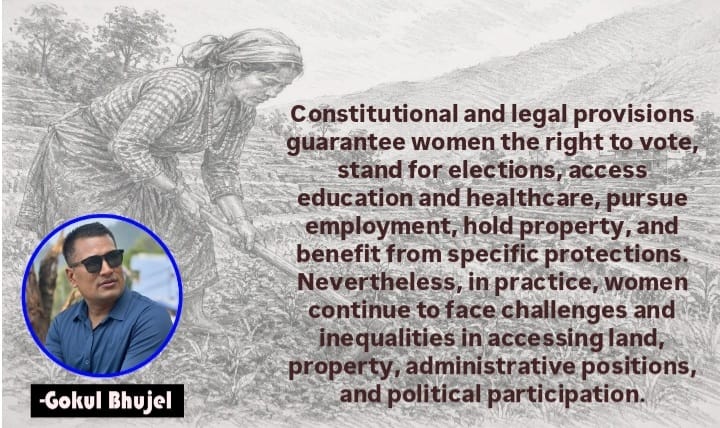
From a political standpoint, the state is understood as an organised entity composed of four essential elements territory, population, government, and sovereignty. It exercises authority and implements laws to regulate the lives of its citizens. A citizen is, therefore, a legal member of the state, entitled to rights and obligations, maintaining a permanent relationship with the nation. In Nepal, women citizens enjoy the same rights and responsibilities as men. Constitutional and legal provisions guarantee women the right to vote, stand for elections, access education and healthcare, pursue employment, hold property, and benefit from specific protections. Nevertheless, in practice, women continue to face challenges and inequalities in accessing land, property, administrative positions, and political participation.Against this backdrop, the issue of women’s access to land and property emerges as particularly sensitive. Historically, gaps between social norms, traditional values, and legal frameworks have hindered the full realisation of women’s rights, thereby affecting their broader social, economic, and political empowerment. It is, therefore, imperative to reconceptualise women’s rights and access to land and property through the lens of feminist jurisprudence, identifying prevailing challenges and exploring opportunities for legal reform, policy development, and social transformation.
Over the past two decades, Nepal has made significant strides in advancing women’s rights, gender equality, and empowerment. Legal reforms, beginning with the amendment of the Muluki Ain in 1975, introduced women’s inheritance and property rights, and subsequent constitutional provisions and international commitments, including CEDAW and UN resolutions, reinforced these gains. Women’s status has improved in education, health, and employment; literacy rose from 25% in 1991 to 57% in 2011, maternal mortality declined sharply, and life expectancy increased. Gender-responsive policies and budgeting have enhanced women’s access to resources and participation in politics and community decision-making.Despite progress, challenges remain. Over 50% of Nepal’s population is female, with rural women contributing extensively to agriculture, yet land ownership among women is only 18–20%. Legal, cultural, and institutional barriers, including patriarchal norms, unclear legislation, and inadequate enforcement, continue to limit women’s access to land and property. Research indicates that land ownership empowers women economically, socially, and psychologically, improving family welfare, decision-making power, and resilience.
This study explores these issues through field research, legal analysis, and comparative experiences, providing insights into Nepal’s policies, challenges, and pathways to strengthen women’s land and property rights.
In Nepal, women’s access to land and property is legally well established but remains limited in practice. The Constitution of Nepal (2015) and the Civil Code (2017) guarantee daughters equal inheritance rights, protect women’s property rights even after marriage, and provide for partition claims, joint ownership, and equal spousal rights. Government policy also encourages registration of land and houses in women’s or joint names by offering tax discounts and reduced fees. However, in reality, the 2021 national census shows that only about 23.8% of households have land or houses registered under women’s names, a small rise compared to 2011. While over 32% of agricultural holdings are reported under women’s leadership, actual control and decision-making power often remain with men. Deep-rooted patriarchal traditions, remaining discriminatory legal provisions, complicated registration procedures, lack of awareness, and fewer land transactions in rural areas continue to limit women’s ownership. Although joint ownership and fee exemptions have encouraged some progress, especially in urban areas, women’s access to land and property is still constrained without broader social change and administrative reforms.
The Role of Women in Land Ownership
Even though the government has introduced provisions such as joint ownership certificates and registration fee exemptions to establish women’s rights over land, much work remains to be done at the implementation level. We often compare land to a mother. Yet, the mothers who nurture the same soil day and night to sustain their families are still deprived of land ownership. Although the Constitution grants daughters the same rights to ancestral property as sons, the main reason for non-implementation is the lack of enforcement.
In rural contexts, women are even more closely connected to land. They contribute significantly to farming and local fairs, yet the wages they receive are lower than men’s. This inequality is closely linked to the issue of women’s rights over land.
Ownership of land ensures that women receive a respected position within the family and community. Alongside this, their participation in law, education, health, and politics should also increase. Land rights lay the foundation for such participation.
Since land is a natural resource, those who work on it should have the priority to own it. From the perspective of social justice, both men and women should have equal rights to ancestral land. Women working in agriculture and rural areas are the real guardians and managers of land. Therefore, land rights are meaningful for their empowerment. Enabling women farmers to become landowners also increases the country’s economic productivity. Simultaneously, violence, discrimination, exploitation, injustice, oppression, and bias against women are reduced. A study conducted by the Community Self-Reliant Service Center in 2012 showed that land ownership reduced violence against women by 75 percent. Only when women are practically given equal rights to production resources through fair distribution of labor can they take responsibility in the public sphere.
However, in recent times, legal pathways for women to claim land rights are gradually opening. The Constitution ensures that gender discrimination is not allowed in ancestral property rights, that women have equal hereditary rights, and that spouses have equal rights in property and family matters.
The Ministry of Land Reform has published the “Procedure for Issuing Joint Land Ownership Certificates, 2074” to support women’s empowerment. Under this procedure, registration fees for documents with female ownership are reduced by 25 to 40 percent, and for single women, a 35 percent discount is applied.
Nepal has also ratified the Convention on the Elimination of All Forms of Discrimination Against Women (CEDAW). Adopted on December 18, 1979, and ratified by Nepal on April 22, 1991, this convention emphasizes that women must be landowners to become economically empowered. It addresses economic and familial benefits and the special rights of rural women.
The Beijing Conference, which is considered highly significant for women’s rights, also emphasized that women should be economically empowered and made landowners. The focus now should be on implementing the Constitution, policies, laws, procedures, and international conventions.
Land Rights Movement
The land rights movement in Nepal began in an organized way in 2061 BS (2004/2005 AD). Discussions on women’s land ownership also started alongside this movement. As the movement for social justice progressed, farmers began receiving tenant rights. However, in tenant families, most of the land was transferred in the names of men, showing that even after long struggles, women remained deprived of these rights.
To change this, women began demanding land registration in their names with revenue discounts and joint ownership arrangements. The movement continued from 2061 to 2067 BS (2004–2010 AD). To pressure the state, an 11-day foot march was organized on International Women’s Day in 2066 BS (2009 AD), starting from three places: Tulsipur in Dang, Kohalpur in Banke, and Bhimdattanagar in Kanchanpur, and ending in Tikapur.
On the occasion of the same day in 2067 BS (2010 AD), 1,000 women from 50 districts gathered at Tundikhel, Kathmandu. They held sit-ins in front of each political party office and the Constituent Assembly building. On the eighth day of the movement, the Deputy Prime Minister and Minister of Education promised to address their demands.
During the movement, a vehicle carrying participants from Bardiya had an accident, resulting in the deaths of two leaders. The women sitting in the sit-in also suffered damage from strong winds. Nevertheless, the movement brought the issue of women’s land rights closer to success. The government agreed to meet their demands. For the fiscal year 2068/69 BS (2011/2012 AD), a policy was introduced stating that joint land ownership certificates issued with the photographs of both husband and wife would incur only NPR 100 in revenue. However, implementation faced some challenges.
Although the registration fee was NPR 100, the notary costs were higher. Moreover, the inconvenience of traveling to district headquarters remained. To remove these difficulties, the Ministry of Land Reform introduced the procedure for joint land ownership certificates. Those seeking joint ownership certificates can fill the forms themselves or with help, without a notary, and if more than 20 families wish to create joint certificates, the Land Revenue Office can issue them in the village itself.
Joint Ownership Campaign
Our social structure is based on joint families, which also involves relationships, love, and harmony among family members. In such an environment, joint ownership has become an appropriate means to establish women’s rights over land. It helps maintain harmony in families and ensures equality in land rights. Buying and selling household land occurs only after consultation, instilling the same values in children. One cannot sell joint land without consent, and if a husband or wife dies, transferring the name is not immediately required.
Moreover, once land is in their names, women can engage in financial activities such as taking loans, starting enterprises, or borrowing and lending, which supports social justice. Ensuring land rights is not only a matter of women but is connected to the overall development of the nation. Although a joint ownership certificate may appear as a simple document, it holds the power of women’s empowerment.
After gaining land rights, women in India and Bodh Gaya have said, “We had legs but could not walk. We had mouths but could not speak. Today, we have land. We can walk, and we can speak.”
Due to policy changes, women’s land ownership has increased in Nepal compared to earlier times. According to the 2068 BS census (2011 AD), 19.71 percent of women had land registered in their names. Currently, this percentage has likely doubled based on the data from the Land Revenue Offices’ land record information systems. According to the Community Self-Reliant Service Center, 10,255 families have issued joint certificates covering 2,781.47 hectares of land.
Challenges in the Campaign
During the land movement, we believed that simply introducing government policies would advance the joint ownership campaign. Policies did come, but the results were not as expected. It is not new for policies, acts, and laws to remain weak in implementation even after women’s movements. Deeply entrenched patriarchal thinking and practices have caused this. Consequently, ancestral property is still practically being transferred mainly to men. Women are considered helpers, called only to sign certificates or place seals.
Policies are still not fully women-friendly. Offices, family members, communities, and political parties often take land ownership in women’s names superficially. Some Land Revenue Office employees deliberately delay policy and procedure implementation, which is another challenge.
Opportunities
In 2074 BS (2017 AD), local elections were held after nearly 20 years. Women were elected at least as deputy chiefs in every village and municipality. They were also given the responsibility of coordinating local judicial committees. Such participation provides an opportunity to advance the joint ownership campaign through local government policies and programs for gender equality. Previously, traveling to district headquarters was mandatory, but now having government offices at the local level has made the process easier. Institutions working for women’s land rights are paying increasing attention. Moreover, when the government provides land to those displaced by natural disasters, tenant farmers, bonded laborers, and squatters, policies specify joint ownership, helping to increase women’s land ownership.
In the coming days, it is necessary to bring to debate the constitutional right stating that children have equal rights to ancestral property without gender discrimination. Judicial committees under municipalities should campaign to raise awareness about women’s land rights. Local government policies and programs must emphasize joint ownership implementation. Advocacy for women-friendly policies should be strengthened. Educational institutions and associations should also be involved for broad promotion and awareness.
Conclusion
Despite legal guarantees, women in Nepal continue to face significant barriers in accessing land and property due to patriarchal norms, weak implementation, and limited awareness. Joint ownership, registration fee exemptions, and constitutional provisions have created opportunities, but social, administrative, and cultural challenges persist. Empowering women through land ownership enhances economic productivity, social status, and decision-making capacity while reducing violence and discrimination. Strengthening policy enforcement, expanding local-level initiatives, raising awareness, and integrating judicial and educational support are essential. Ensuring women’s land rights is not only a matter of justice but a vital step toward sustainable national development and gender equality.
Recommendations for Enhancing Women’s Land Rights in Nepal
- Policies ensuring joint land ownership and registration fee exemptions should be fully implemented so that women’s legal rights are realized in practice.
- Awareness campaigns must be conducted at local levels to educate families, communities, and officials about women’s equal inheritance and property rights.
- Administrative procedures for land registration should be simplified, especially in rural and geographically remote areas, to reduce bureaucratic obstacles.
- Women’s land ownership initiatives should be integrated with local governance, judicial committees, and educational institutions to enhance empowerment and participation.
- Regular monitoring and evaluation of land-related policies are essential to address patriarchal norms, discriminatory practices, and gaps between law and implementation.
Author: The author is a scholar and policy analyst specializing in public administration, sustainable development, and legislative drafting.
Reference
Constitution of Nepal, 2015. Kathmandu, Nepal: Nepal Law Commission.
Government of Nepal. (2015). The Constitution of Nepal 2072 (2015). Kathmandu, Nepal: Office of the Prime Minister and Council of Ministers.
Land Related Act, 2021 BS (1964/65 AD). Kathmandu, Nepal: Nepal Law Commission.
Land Revenue Act, 2034 BS (1977/78 AD). Kathmandu, Nepal: Nepal Law Commission.
Land Revenue Regulations, 2036 BS (1979/80 AD). Kathmandu, Nepal: Nepal Law Commission.
Land Related Rules, 2036 BS (1979/80 AD). Kathmandu, Nepal: Nepal Law Commission.
Land Dispute Resolution Commission Formation Order, 2081 BS (2024/25 AD). Kathmandu, Nepal: Nepal Law Commission.
Ministry of Land Management, Cooperatives and Poverty Alleviation. (2074 BS / 2017 AD). Procedure for issuing joint land ownership certificates. Kathmandu, Nepal: Government of Nepal.
Department of Land Management and Records, Babarmal, Kathmandu. (2078–2081 BS). Annual progress reports of the LRMIS system. Ministry of Land Management, Cooperatives and Poverty Alleviation, Nepal. (Unpublished).
Community Self-Reliant Service Center (CSRC). (2012). Impact of land ownership on reducing violence against women in Nepal. Kathmandu, Nepal: CSRC.
CSRC. (2019). Annual progress report on women’s land ownership and empowerment initiatives. Kathmandu, Nepal: Community Self-Reliant Service Center.
International Organization for Migration. (2016). Barriers to women’s land and property access and ownership in Nepal. Baluwatar, Nepal: Author.
United Nations. (1991). Convention on the Elimination of All Forms of Discrimination Against Women (CEDAW). New York, NY: United Nations.
Karki, K. (2022, January 28). The role of women in land ownership. Himal, 2078 Magh issue,